
The state of Sheffield Hallam University’s finances is perilous. University management blame this on external factors beyond their control. We do not accept this simple, unreflective narrative. In our Sheffield Hallam: UCU State of the University Report 2025, we provide a detailed analysis of the last 14 years to reveal a series of reckless decisions taken by University management which have significantly contributed to the present-day crisis.
We call for a government-led public inquiry into the (mis)management of public monies at Sheffield Hallam University. We call on the University management to overhaul its governance, radically improve transparency and accountability, and withdraw its threat of compulsory redundancies.
Executive Summary:
- The University made £40 million worth of cuts in 2024/25 and threatens another £28 million (more recently revised to £31 million) worth of cuts commencing in 2025/26. 1000 jobs have been lost at the University over the past two years.
- These staggering job losses are undermining the offer to students, with rising class sizes, cuts to the curriculum and fewer resources for student support.
- There was no big cash windfall for Sheffield Hallam University from the tripling of tuition fees in the 2010s. Yet over the last decade, University management began to engage in increasingly unsustainable spending.
- While total income tracked inflation up to 2023, expenditure remained consistently above inflation from 2015 onwards. The largest increase in expenditure above the level of inflation has been ‘interest and other finance costs’ (i.e. servicing debt).
- Since 2017, the University has consistently made a loss (before actuarial adjustments).
- The new city campus buildings are being paid for through existing funds and a £70 million loan taken out at the beginning of 2022. Taking out such a large loan in early 2022, when income from home undergraduate students was beginning to plateaux and then decline, was high risk and irresponsible.
- As a result of the latest campus development, long-term borrowing at the University has increased considerably. At the start of the period 2011-2024, the University held a £74 million debt for the period 2007-2014. While this initial loan was starting to be paid back over the period 2014 to 2021, the taking on of the further loan in 2022 has caused debt to escalate significantly.
- One of the more misguided attempts to increase the income of the University has been the plans to invest in a satellite campus at Brent Cross, London. Tacit acknowledgment that UCU’s concerns about this venture were well-founded came in early 2025 when the University announced it was tendering for a subcontractor to manage and operate the campus. This arrangement is presumably aimed at mitigating any losses from the subsidiary.
- Over recent years, the senior management team at Sheffield Hallam University has increased expenditure on the pay of senior staff, in a manner that has not been commensurate with performance. As reported by the TaxPayers’ Alliance (TPA), Sheffield Hallam University fell 75 places in the Centre for World University Rankings between 2020 and 2024. This placed the University among the worst ten UK universities for a fall in rankings during those four years. Yet in the same period the number of staff paid in excess of £100,000 increased eightfold, from 14 to 112, the greatest increase of any University responding to the TPA’s Freedom of Information request.
- Sheffield Hallam University has a stronger multiplier effect than many other UK universities (with every 1 job at the University supporting 2.54 jobs in the local economy). The loss of 1000 jobs over the past two years at the University (and the prospect of more job losses) has and will continue to have a detrimental effect on the city and region.
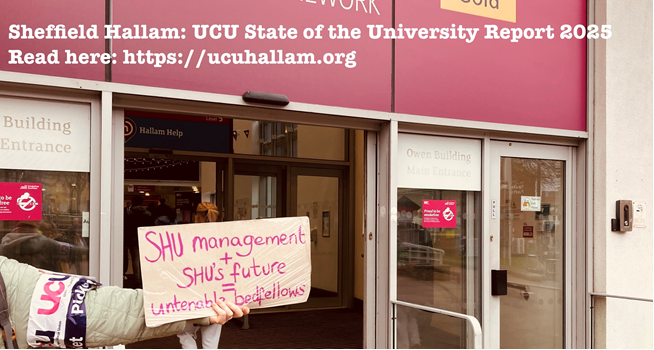
- We conclude that Sheffield Hallam University’s management and the future of our University are ‘untenable bedfellows’, threatening the survival of the institution.
- UCU Sheffield Hallam Branch is campaigning to ‘Save Sheffield Hallam’ and continues to offer alternative solutions to the crisis at the University.
The full report is available to read below.